
In this day and age, wireless speakers have become a staple in many homes. They let us play music and podcasts without wires. But one question is paramount when deciding on the right speaker: Bluetooth vs. Wi-Fi. Both technologies are great for wireless streaming. But each has its own advantages, depending on how you plan to use them.
You should keep these differences in mind when choosing the speaker who best matches your life. This article will outline the benefits, drawbacks, and alternatives you should consider when making your decision.
What Are Bluetooth and Wi-Fi Connections in Speakers?
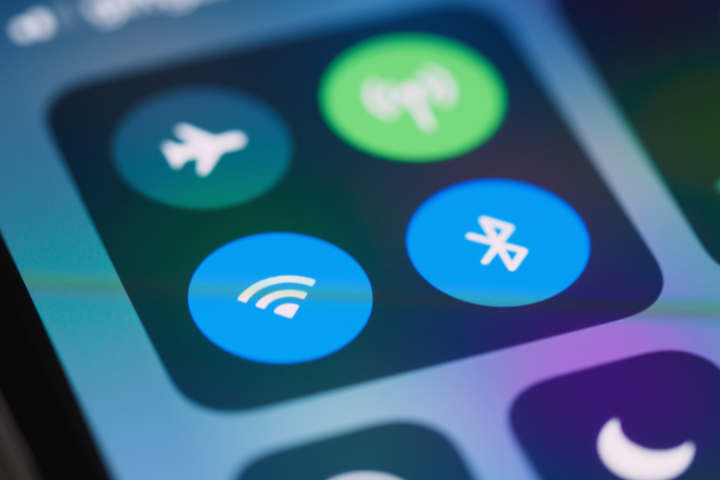
Bluetooth
Although the tech range is short, Bluetooth wireless technology still makes connecting easy and fast. Your smartphone, tablet, PC, or computer can all link up to a speaker from about 30 feet indoors. And here’s the best part — Bluetooth doesn’t need the internet to work.
This makes it perfect for portable speakers that can be taken almost anywhere. Whether you’re at the park, school, or anywhere else, you can use them whenever and wherever you want. It’s that simple!
Wi-Fi
Wi-Fi speakers, however, can be connected to your home network and play music over a much wider distance than Bluetooth devices. They not only offer better sound quality but also let you pair multiple speakers so that the music can fill your entire home.
The only requirement is a stable internet connection. Because of this, Wi-Fi is perfect for home audio systems, especially when using services like Spotify or Apple Music. It ensures smooth, high-quality streaming throughout your house.
Bluetooth vs Wi-Fi: Pros and Cons
Bluetooth Speakers
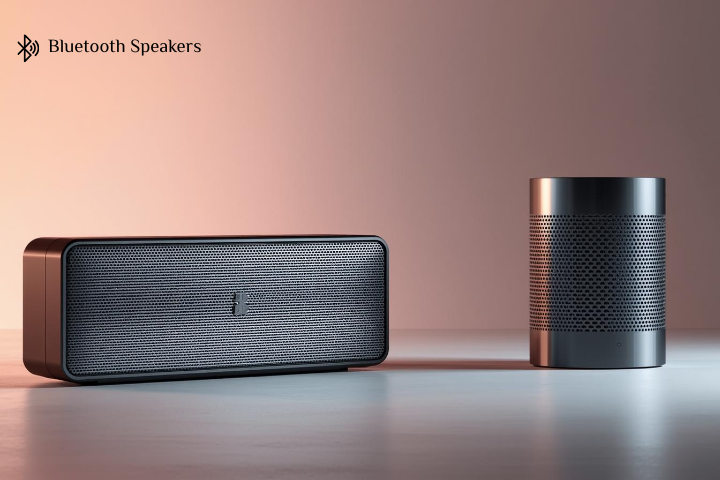
Pros
- Easy Setup: Setting up Bluetooth Speakers is a breeze. Just pair, and you’re ready to go — no need for Wi-Fi or complex settings.
- Portability: These speakers are small and lightweight, battery-powered, and you can take them with you wherever you go. Made, for instance, in the outdoors, nearby mountains, or when one’s out at sea.
- Affordability: Bluetooth speakers generally fall into the budget category, so you can let loose and have fun without running dry on cash.
- No Internet Required: You can use Bluetooth speakers anywhere, with or without Wi-Fi. They’re great for outdoor trips, travelling abroad, and simply hanging out in places without connection if you don’t know any better.
Cons
- Narrow Range: Bluetooth has a more limited effective range (typically 30 feet indoors at best). If you are too far away from the signal source, it can also cause problems with the signal connection.
- Lower Audio Quality: When transmitting wireless audio via Bluetooth, some compression is necessary, which often results in sound that’s worse than CD-quality compared to Wi-Fi speakers.
- Single Device Connection: For the most part, Bluetooth carries only one device connection at a time, which limits potential multi-user or multi-device arrangements.
✏ Recommended for: Casual listening, portability, outdoor use, and occasions when ease of setup and affordability are more important than anything else.
Wi-Fi Speakers
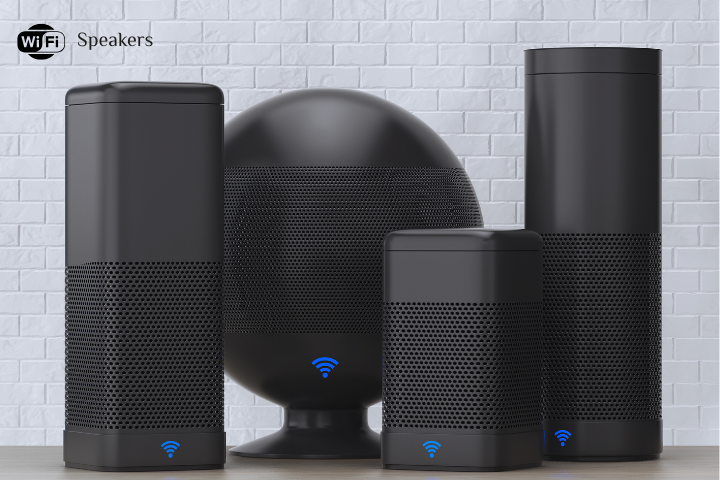
Pros
- Higher Audio Quality: Wi-Fi offers better audio quality. It supports uncompressed audio. It can handle 24-bit 96kHz sampling rates. This makes it superior to Bluetooth speakers.
- More extended Coverage: Wi-Fi has a much greater range, making it perfect for home use. You can broadcast throughout the whole place if your network is strong enough.
- Multi-Room Audio: One of the main advantages of Wi-Fi is that it can link and coordinate multiple speakers simultaneously, and keep your home music uninterrupted.
- Streaming services: Wi-Fi speakers can play music directly from services like Spotify or Apple Music—without needing your phone.
Cons
- More set-up required: Wi-Fi speakers require a stable home network. They need more configuration than Bluetooth speakers. This setup is often done through an app or web interface.
- Power Supply: Wi-Fi speakers generally require a mains power outlet and are less portable than battery-powered Bluetooth gadgets.
- Higher cost: Owing to their additional features and better sound quality, Wi-Fi speakers tend to be more expensive than Bluetooth alternatives.
💡 Best used for: Home audio systems and high-quality enthusiasts — WiFi improves sound quality and offers better streaming capacity.
Comparison Table: Bluetooth vs Wi-Fi Speakers
| Feature | Bluetooth Speaker | Wi-Fi Speaker |
|---|---|---|
| Range | Up to 30 feet indoors; shorter in crowded spaces. | Covers the entire home (based on the Wi-Fi network’s range). |
| Audio Quality | Compressed audio, lower sound fidelity. | Higher sound quality, supports uncompressed audio. |
| Setup | Quick and easy pairing, no internet required. | Requires network setup and app configuration. |
| Portability | Highly portable, battery-powered. | Generally stationary, it requires a constant power source. |
| Multi-Room Setup | Not possible, can only pair with one device at a time. | Easily supports multi-room audio setups. |
| Cost | Generally, more affordable. | Higher price due to advanced features and better audio. |
| Best For | Casual listening, outdoor use, portability. | Home setups, audiophiles, smart home integration. |
What to Think About Before Buying

01. Sound Quality
Wi-Fi is the preferred method among those who value high-quality, dynamic sound. Wi-Fi is bathybius le! Thus, it can support higher bitrates and, when used with uncompressed audio, offers a purer sound.
Bluetooth, however, often compresses audio, leading to a lack of clarity. However, in casual music listening, this defect may be hardly noticeable.
02. Distance and Connectivity
Bluetooth is ideal for short-range and personal use. Since it works within a specific radius, a beach or park gathering is an appropriate setting for a hearing.
However, is designed for long-range use. It can cover many rooms and is very suitable for home setups if you want the best possible range.
03. Convenience
For Bluetooth speakers, several steps can help you use them immediately. But for Wi-Fi speakers, it often takes you to set up the machine, adjust your home network settings, and then download a specific application. This kind of experience won’t be appreciated by those who want simple operation over all else.
Volume and Battery
Bluetooth speakers are usually volume-controlled and portable, with built-in batteries to avoid the wires. In contrast, Wi-Fi speakers must have a steady power supply. This limits their portability to some extent.
For more on sound technologies, check out our article on Noise Cancelling vs Passive Noise Isolation.
Which Should You Choose: Bluetooth or Wi-Fi?
At the end of the day, your choice between Bluetooth and Wi-Fi depends on how you live and what you want to use the speaker for. If you value portability, affordability, and ease of use, a Bluetooth speaker will prove just right.
And for those who want higher sound quality, multi-room capabilities, and streaming services, give yourself a Wi-Fi speaker instead.
If you’re on the lookout for something that combines the best features of both, consider devices with interfaces for both Bluetooth and Wi-Fi: they offer optimal use.
⟳ Post on Dec 26, 2025



0 Comments